13 Silver Ombre Hair Ideas: Stunning Metallic Looks for a Modern Edge
Silver ombre is one of the most striking and technically demanding hair color looks available — it requires careful bleaching and toning to achieve the cool, metallic quality that separates true silver from simply bleached blonde, and the gradient effect of the ombre technique adds a depth and drama that solid silver can’t match. The result, when executed well, is hair that appears almost otherworldly: cool, luminous, and metallic in a way that no natural hair color can replicate.
These 13 silver ombre hair ideas span the full range of the technique — from soft, barely-silver fades to dramatic dark-to-silver transformations and unexpected color combinations at the tips.
13 Silver Ombre Hair Ideas
1. Silver Ombre with Lavender Tips

Adding soft lavender tips to a silver ombre creates a gradient that moves through three tonal zones: the natural or darker root, a transitional silver mid-length, and a soft purple-lavender at the ends. The lavender quality at the tips comes from a diluted purple toner or a direct dye mixed with conditioner, giving a sheer, petal-like quality that enhances rather than overwhelms the silver ombre beneath. In certain lighting conditions, the lavender appears distinctly purple; in others, it blends almost invisibly into the silver.
Best for: Fair and cool-toned skin. Pre-lightened hair at a pale silver or white base.
Color tip: Use a purple direct dye mixed at a 1:3 ratio with white conditioner for the most sheer, natural-looking lavender that won’t overpower the silver gradient.
2. Frosted Silver Waves
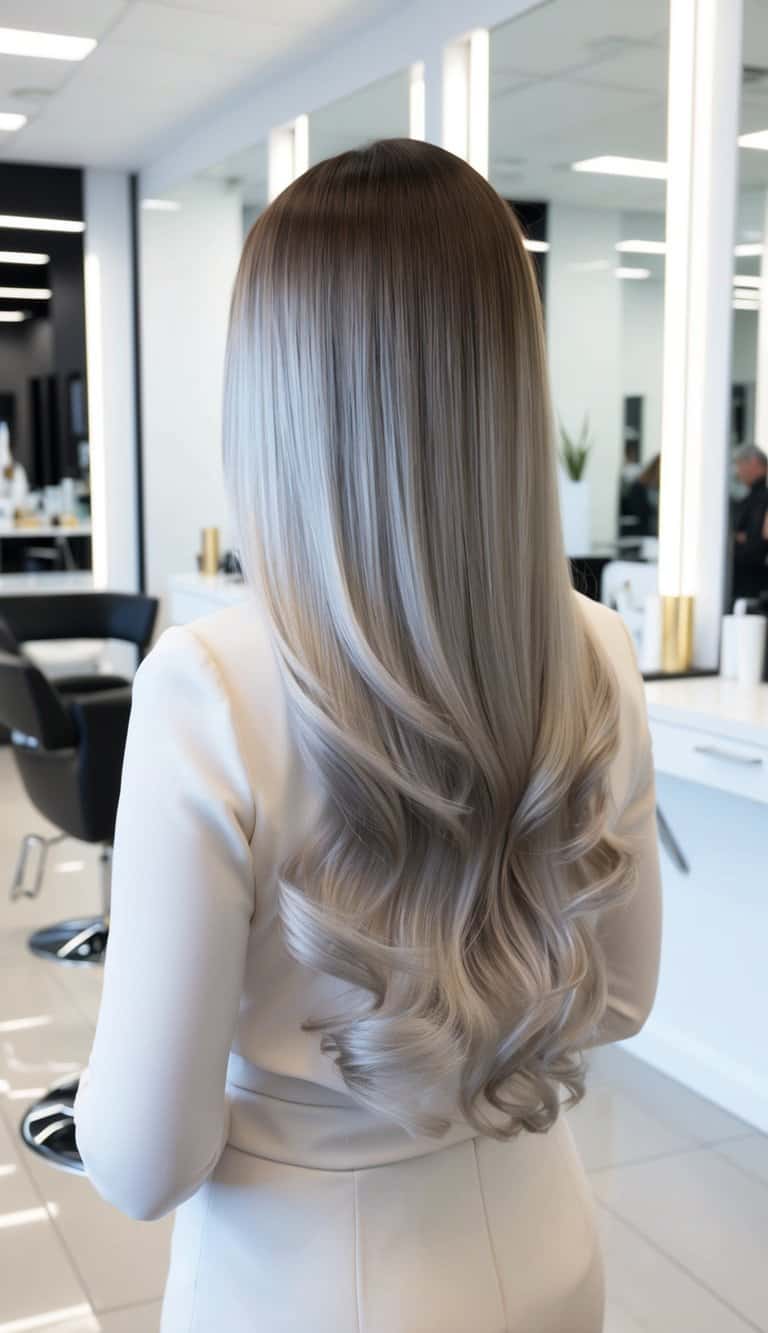
Frosted silver waves combine a silver ombre color with loose, flowing wave styling to create a look that evokes frost crystals and winter light. The frosted quality comes from the combination of the silver tone and the wave pattern — each wave alternates between catching the light (appearing bright, almost white silver) and falling into shadow (appearing darker, cooler grey). The interplay of light and shadow created by the waves gives the color a three-dimensional quality that flat, straight styling can’t achieve.
Best for: Medium to long hair. Fair and cool skin tones.
Styling tip: Use a wide-barrel curling wand and alternate curl directions for natural-looking waves. A silver-toned shine spray applied before curling enhances the frosted, light-catching quality of the finished style.
3. Metallic Silver Ombre Waves

Metallic silver ombre achieves a distinctly industrial, mirror-like quality — the silver tone here is brighter and more reflective than softer grey-silver variations, creating a genuinely metallic appearance that’s closer to polished steel than to natural grey hair. This effect requires achieving a very pale, almost white base before applying a clear or silver-tinted gloss to maximize the light-reflecting quality. The result photographs dramatically and makes a strong visual statement in person.
Best for: Bold style preferences. Fair to medium skin tones with cool undertones.
Color tip: After bleaching to the palest possible blonde, apply a clear gloss with a small amount of silver or violet toner rather than heavy grey pigment — the near-clear application creates a metallic sheen without adding the flat grey that can make the color appear dull.
4. Charcoal to Silver Ombre

Charcoal to silver ombre creates one of the most dramatic and high-contrast versions of the silver gradient — the deep, almost-black charcoal root transitions through progressively lighter grey tones before arriving at a bright, metallic silver at the ends. The charcoal base requires either natural dark hair or a dark grey or black color application, while the silver ends require significant lightening and precise toning. The contrast between the two extremes creates a striking visual impact at every length.
Best for: Those who want maximum contrast and visual drama. Works on all skin tones.
Maintenance tip: The charcoal root and the silver ends require different maintenance strategies — the dark root can be refreshed with a grey direct dye, while the silver ends need regular violet toning to prevent them from warming toward yellow.
5. Silver Ombre for Long Layers

Long layered hair provides the ideal canvas for silver ombre because the layers create multiple planes of color visibility — each layer reveals a different point in the gradient, so the full ombre transition is visible simultaneously across the entire hairstyle rather than only at the very ends. On layered hair, the silver sections appear at different lengths throughout the style, creating a more complex and dynamic color effect than the same gradient would produce on blunt-cut hair.
Best for: Long layered hair. All skin tones — the layered distribution of silver makes this one of the more universally flattering silver ombre applications.
Styling tip: Blow-dry with a round brush to maximize the smoothness and shine of each layer, allowing the silver gradient to read as clearly as possible at every plane of the style.
6. Marble Silver Ombre

Marble silver ombre uses an irregular, veined placement technique inspired by natural marble stone — rather than a smooth, even gradient from root to tip, the silver tones are applied in streaks, swirls, and irregular sections that mimic the unpredictable pattern of marble veining. The result is a more complex and visually interesting color than standard ombre, with visible variation in the placement and intensity of the silver that creates an almost artistic quality.
Best for: Those who want a unique, art-inspired color effect. Medium to long hair where the marble pattern has room to develop.
Color tip: Request freehand painting from a colorist who specializes in creative techniques — the marble effect cannot be achieved with foils or standard sectioning, and requires the kind of intuitive, artistic placement that distinguishes skilled balayage artists.
7. Silver Ombre with Ice Blue Tips

Ice blue tips added to a silver ombre create a look that’s simultaneously cool, ethereal, and futuristic. The ice blue at the ends occupies the coolest possible position on the color spectrum — almost white with a barely-perceptible blue tint — which harmonizes naturally with the silver’s cool metallic quality rather than contrasting against it. The effect is subtle in most lighting but reveals itself clearly in natural or cool-toned light, creating a hidden depth that rewards close inspection.
Best for: Fair skin with cool undertones. Hair pre-lightened to a near-white base.
Color tip: Achieve ice blue by applying a blue direct dye mixed at a 1:4 or 1:5 ratio with white conditioner — higher dilution creates the icy, barely-there quality rather than a saturated blue.
8. Silver Ombre with Magenta Ends

Magenta ends on a silver ombre create the most striking color contrast in this collection — the cool, metallic silver and the vibrant, warm magenta sit at opposite ends of the color relationship spectrum, creating a visual tension that makes the combined look genuinely eye-catching. The transition from silver to magenta typically occurs over a short section at the lower lengths, making the color shift dramatic and precise rather than gradual. This is the choice for those who want their hair color to be unmistakably intentional and bold.
Best for: Those who enjoy bold, fashion-forward color. All skin tones — the combination works across complexions because the contrast draws attention to the hair rather than comparing it to the skin tone.
Maintenance tip: Magenta fades quickly toward a warm pink, then peachy blonde. Refresh with a magenta direct dye every 4–6 weeks to maintain the vibrancy of the color contrast.
9. Silver Ombre with Shadow Root

A shadow root on silver ombre adds a deliberately dark root section that creates a seamless, low-maintenance starting point for the silver gradient. Rather than the root appearing as an untended grow-out, the shadow root is an intentional design element — a smudged, diffused dark section at the roots that transitions organically into the silver below. This technique eliminates the stark regrowth line that makes most silver ombre high-maintenance and allows longer gaps between salon visits.
Best for: Those who want silver ombre with reduced maintenance. All skin tones.
Maintenance tip: With a shadow root, salon visits can be extended to every 3–4 months rather than every 6–8 weeks — the intentional dark root means natural regrowth simply blends into the designed shadow rather than appearing as neglect.
10. Silver Ombre with Amethyst Tint

An amethyst tint over silver ombre adds a purple-violet quality to the metallic tone that creates a more complex and jewel-like result than pure silver alone. The amethyst quality comes from a diluted violet or purple toner applied over the silver sections — in most lighting the hair reads as silver, but in direct light the purple undertone becomes visible as a warm, gemstone-like shimmer within the cool metallic base. This is one of the most sophisticated and nuanced silver ombre variations.
Best for: Cool and neutral skin tones. Those who want silver with added depth and complexity.
Color tip: A purple-tinted toning shampoo used weekly serves double duty — it maintains the violet quality of the amethyst tint while also preventing the silver from warming toward yellow, eliminating the need for separate toning steps.
11. Dark Brown to Silver Ombre

Dark brown to silver ombre is the most dramatic and technically demanding variation in this collection — taking hair from its darkest natural brown state all the way to a bright, metallic silver at the ends requires the most extensive lightening process of any ombre technique. The brown-to-silver transition passes through every shade of warm and cool brown, caramel, golden blonde, and pale blonde before reaching the silver endpoint, making the gradient longer and more complex than lighter-base-to-silver ombres. The visual impact of the finished look is exceptional.
Best for: Those willing to commit to the lightening process required. All skin tones — the warm brown root complements virtually every complexion, while the silver ends create a striking modern contrast.
Color tip: This transition typically requires 2–3 salon sessions rather than one — attempting to go from dark brown to silver in a single appointment risks significant damage. A gradual approach preserves the hair’s integrity and produces a better final result.
12. Shimmering Silver Ombre

Shimmering silver ombre prioritizes the light-catching, iridescent quality of the silver tone above all other considerations — the color is formulated and finished specifically to maximize shimmer, using gloss treatments, shine sprays, and precision toning to achieve a result that appears to move and shift as the light changes. In motion, shimmering silver ombre creates a cascading, liquid-metal effect that makes the hair appear genuinely luminous rather than simply well-colored.
Best for: Medium to long hair where movement amplifies the shimmer effect. Fair and cool-toned skin.
Styling tip: Apply a lightweight, high-shine serum to dry hair before any activity where the hair will move — the serum enhances the light-catching quality of the silver and creates the signature shimmer effect the style is designed for.
13. Matte Charcoal to Silver Ombre

Matte charcoal to silver ombre takes the charcoal-to-silver gradient and applies it with a deliberately low-gloss, matte finish — the absence of shine creates a flat, almost velvet-like quality that reads as more editorial and fashion-forward than the high-gloss interpretations of the same color scheme. The matte finish is achieved through product application (matte styling creams, paste, or spray) and by avoiding finishing products that add shine. The result is strikingly modern and unexpected.
Best for: Those with an avant-garde or fashion-forward aesthetic. All skin tones.
Styling tip: Apply a matte texturizing paste through dry hair after styling, working it through the lengths to eliminate any shine. Avoid touching the hair with oily hands, which restores unwanted gloss to the matte surface.
How to Achieve Silver Ombre
- Start with a professional consultation: Silver ombre is one of the most technically demanding hair color transformations, particularly on dark hair. A consultation with an experienced colorist who specializes in silver or grey hair is essential before beginning the process.
- Bleach in stages: On medium to dark hair, achieving the pale base needed for true silver requires multiple lightening sessions. Attempting to reach the target level in one session risks severe breakage. A staged approach — lightening over 2–3 appointments — produces safer and better results.
- Tone precisely: Silver is created by applying a cool, grey or violet toner over a pale blonde base, not by lightening alone. The toner’s formulation determines whether the result reads as warm silver, cool silver, or grey — discuss the exact shade with your colorist before toning.
- Maintain the tone: Silver fades toward warm yellow or gold as the toner oxidizes. Use a purple or blue shampoo twice weekly and a toning treatment every 4–6 weeks to maintain the cool, metallic quality of the color.
Frequently Asked Questions
Can you get silver ombre on dark hair?
Yes, but it requires significant pre-lightening. Dark hair must be lifted to at least a level 9 or 10 (pale blonde or near-white) before a silver toner will produce a true metallic result. On dark hair, this typically means 2–3 bleaching sessions spaced 4–6 weeks apart, with deep conditioning treatments between sessions to maintain the hair’s health. The dark-to-silver transition is the most dramatic and impactful variation of silver ombre, but it’s also the most time-intensive to achieve safely.
How do I keep silver ombre from turning yellow?
Yellow tones develop in silver ombre as the violet or grey toner fades and the underlying warm blonde base reasserts itself. Prevention involves using a purple shampoo every second or third wash (not every wash — overuse causes an unwanted purple tint), applying a blue or violet toning conditioner weekly, limiting heat styling which accelerates color fade, and scheduling a toning gloss every 6–8 weeks. Avoiding direct sun exposure and using UV-protective products also slows the warm-up process significantly.
How long does silver ombre last?
The silver tone itself typically lasts 4–8 weeks before noticeable fading occurs, depending on hair porosity, wash frequency, and product use. However, the ombre structure (the gradient from root to ends) lasts until the hair is cut — only the tone requires refreshing, not the placement. With regular toning maintenance, silver ombre can be kept looking fresh for many months before the color placement needs to be revisited.
Final Thoughts
Silver ombre is not a casual color commitment — achieving it well requires significant technical work, and maintaining it requires consistent product use and regular toning. But the results, when done right, are among the most visually striking in modern hair color: cool, metallic, and deeply modern in a way that warmer hair colors simply cannot replicate.
The 13 variations here represent the full creative range of what silver ombre can become — from the classic frosted waves to the unexpected magenta tips, the core silver gradient is a foundation that can be customized endlessly. Whatever interpretation appeals most, the technical foundation is the same: a well-lightened, precisely toned base that gives the silver color its maximum metallic impact.