27 Teal Ombre Hair Ideas: Bold Aquatic Looks for Every Style
Teal ombre hair occupies a uniquely captivating position in the world of color-treated hair — vivid enough to make a genuine statement, but grounded in the natural palette of ocean water and tropical landscapes in a way that feels organic rather than artificial. Teal exists at the intersection of blue and green, carrying the depth and mystery of deep water alongside the freshness and vitality of tropical flora. Applied as an ombre gradient, teal creates a hair color that appears to shift and change with movement and light — deep and saturated in the shadows, bright and aquatic in the light.
These 27 teal ombre hair ideas span the full creative range of the color — from soft, barely-there aqua fades to dramatic dark-root-to-vivid-teal transformations and unexpected color combinations.
27 Teal Ombre Hair Ideas
1. Turquoise Dream Teal Ombre

Turquoise dream teal ombre shifts the color slightly toward the blue end of the teal spectrum, creating a vivid, tropical turquoise that evokes Caribbean waters and clear summer skies. The dream quality comes from the gradual, almost luminous way the turquoise develops along the hair’s length — from a darker, more teal-blue root to a brighter, more intensely saturated turquoise at the tips. In sunlight, this color has a genuinely extraordinary quality, appearing to glow from within with a blue-green light that no natural hair color can replicate.
Best for: Fair to medium skin tones. Pre-lightened hair — turquoise achieves its most vivid quality on a pale blonde base.
Color tip: A semi-permanent turquoise direct dye applied to a level 9–10 blonde base creates the most vivid result. On darker bases, the turquoise reads darker and more blue-toned, which creates a different but equally beautiful result.
2. Jade Embrace Gradient

Jade embrace gradient shifts teal toward the green end of the spectrum, creating a color that evokes polished jade stone — rich, slightly muted green with a depth and complexity that makes it read as sophisticated rather than vivid. The jade quality comes from a slight desaturation of the teal tone — it’s not forest green or emerald, but the specific blue-green of carved jade, which has a mineral, almost translucent quality. Applied as a gradient, jade ombre creates a color that’s genuinely unique and instantly recognizable.
Best for: Warm and olive skin tones where the green undertone of jade complements the skin’s warmth. Medium to long hair.
Color tip: Mix a teal and a grass-green direct dye at approximately a 2:1 ratio (teal to green) to achieve the jade quality — pure teal reads too blue, while more green creates the specific jade tone.
3. Aquatic Allure Teal Ombre

Aquatic allure teal ombre captures the full range of underwater color — from the darker, deeper teal of the ocean’s mid-depths through progressively lighter, more aqua tones at the ends. The allure quality comes from the way the color appears to move and shift: in motion, the hair reveals multiple tones within the teal family, creating the impression of water in motion. The gradient is bold enough to make a statement but varied enough within the teal palette to avoid appearing flat or one-dimensional.
Best for: All skin tones. Medium to long hair where the full range of aquatic tones can develop.
Styling tip: Loose, flowing waves and curls enhance the aquatic quality — the movement creates variation in how light hits each section, revealing the depth and complexity of the multitonal teal gradient.
4. Lagoon Bliss Ombre

Lagoon bliss ombre draws from the color of a shallow tropical lagoon — a clear, bright teal that has the transparency and luminosity of water over white sand. The lagoon quality comes from the brightness and clarity of the teal tone rather than its depth — this is a lighter, more aqua interpretation of teal that reads as fresh and tropical rather than deep and mysterious. Applied as an ombre from dark roots, the lagoon teal appears brightest at the ends, creating the impression of hair dipped in tropical water.
Best for: Fair to medium skin tones. All hair lengths — the bright, clear quality of lagoon teal suits shorter hair particularly well, where the vivid tone can be fully appreciated without the dilution of length.
Color tip: Dilute a standard teal dye with a small amount of aqua or light blue to achieve the transparent, lagoon quality — full-strength teal is slightly too saturated for this look.
5. Azure Delight Tips

Azure delight tips concentrate the teal-adjacent color at the very ends of the hair in a more deliberate, visible tipping technique. The azure quality shifts the tone toward a brighter, more blue-dominant version of teal — the ends appear almost cornflower or sky blue in certain lighting but reveal their teal character in others. The delight quality refers to the unexpected pleasure of discovering the vivid azure tips when the hair moves, as they’re largely hidden within the darker surrounding hair until movement reveals them.
Best for: Those who want a more subtle introduction to vivid hair color. All base colors — the tips-only technique works on unbleached dark hair if full-coverage vivid dye is used, though the color will appear darker and more muted on unlightened sections.
Styling tip: Hair worn down and in motion best shows off the azure tips — pinned-up styles hide the vivid ends completely, which can be either an advantage (professional settings) or a disadvantage depending on the goal.
6. Cool Mint Fade

Cool mint fade is the softest, most pastel interpretation of teal ombre — the color at the ends is so diluted with white or conditioner that it reads as a barely-there mint or pale aqua rather than vivid teal. The fade technique makes the transition from the darker sections to the mint ends exceptionally gradual and diffused, creating a color that appears almost ombre-less in its seamlessness. This is the ideal choice for those who want a subtle, fashion-forward color without the commitment of full vivid teal.
Best for: Fair skin tones. Pre-lightened hair where the pale base allows the mint quality to show clearly. Those who prefer pastel over vivid color.
Color tip: Mix teal direct dye with white conditioner at a 1:5 or 1:8 ratio for the pastel mint quality — more dye creates a standard teal, less creates a barely-perceptible aqua wash.
7. Breathtaking Bay Ombre

Breathtaking bay ombre draws from the colors of a sheltered coastal bay — the deeper, slightly muted teal of protected waters, calm and rich rather than bright and tropical. The bay quality gives this teal ombre a slightly more sophisticated, less vivid character than lagoon or turquoise interpretations — it’s a teal that reads as marine and nautical rather than tropical and vivid. The breathtaking quality comes from the way the color develops along the length, creating a gradient that appears effortlessly natural despite being unmistakably vivid.
Best for: All skin tones. Medium to long hair. Those who want vivid teal with a slightly more subdued, sophisticated character.
Color tip: Add a small amount of dark blue or indigo to a standard teal dye to achieve the bay quality — the additional blue depth gives it the slightly muted, protected-water character.
8. Daring Depths Teal

Daring depths teal is the most dramatic and boldly saturated interpretation in this collection — a deep, rich, fully saturated teal that starts dark at the roots and becomes progressively more vivid (rather than lighter) toward the ends. The daring quality comes from the commitment to maximum color intensity: no pastels, no dilution, just the most vivid teal achievable on a properly pre-lightened base. The depths element references the deep ocean color palette — these are not tropical surface waters but the rich, saturated teal of deeper ocean zones.
Best for: Those who want maximum color impact. Fair to medium skin tones. Pre-lightened hair.
Maintenance tip: Bold, deeply saturated teal fades more dramatically than pastel interpretations — budget for toner or color refresh appointments every 4–6 weeks to maintain the vivid quality.
9. Lush Lagoon Transition

Lush lagoon transition is a more generous, full-coverage interpretation of lagoon teal — where lagoon bliss concentrates the color at the ends, lush lagoon distributes the teal generously through most of the hair’s length, creating a more immersive color experience. The lush quality comes from the abundance and saturation of the teal tone, while the transition refers to the gradient that brings the darker root into the vivid lagoon teal. The result is hair that appears lush and saturated from root to tip, with only the roots retaining their natural depth.
Best for: Those who want the maximum coverage teal ombre look. Fair to medium skin tones. Long hair where the lush coverage can be fully appreciated.
Styling tip: This look is statement-making enough to work with simple, clean styling — a straight blowout or simple ponytail lets the color be the focus without competing with elaborate styling.
10. Frosted Aqua Ombre

Frosted aqua ombre adds a cool, icy quality to the aqua-teal gradient — the ends appear almost crystalline, as though the aqua tone has been set in ice. The frost quality comes from the addition of silver or white highlights within the aqua sections, creating a multitonal shimmer that reads as both aqua and silver simultaneously in certain lighting. The combination of the vivid aqua and the icy silver creates a color with genuine complexity and depth, appearing different from every angle.
Best for: Cool skin tones. Pre-lightened hair. Those who want the visual complexity of a multitonal color within the aqua-teal family.
Color tip: Apply the aqua dye first, then add a few very fine highlights through the lighter sections using a silver toner — the silver highlights within the aqua create the frosted quality without requiring a separate color application.
11. Effervescent Emerald Ends

Effervescent emerald ends shift teal’s blue-green balance firmly toward the green, creating ends that read as emerald rather than aqua. The effervescent quality adds a sparkle and liveliness to the emerald tone — this isn’t the deep, static emerald of gemstones but a vibrant, bubbling green that appears to move and change with every shift of light. Applied only at the ends, the emerald creates a dramatic contrast against natural or darker root colors, making the tips appear as though they’ve been dipped in a vivid green cocktail.
Best for: Warm and olive skin tones where the green complements the warm undertones. All hair lengths.
Color tip: A true emerald green dye mixed with a small amount of teal creates the blue-green hybrid that reads as emerald rather than forest green — pure green dyes can read too yellow-green on some bases.
12. Sparkling Aqua Tips

Sparkling aqua tips concentrate a bright, clear aqua at the very ends and add a sparkling, glittery quality through the use of shimmer-tinted styling products or metallic pigments mixed into the color. The sparkling element means this look changes dramatically between regular light and direct sunlight or bright lighting — in subtle lighting it appears as a soft aqua tip, while in bright light the sparkle reveals itself in a constellation of light-catching glitter. This is one of the most visually dynamic entries in the collection.
Best for: Those who want a color that performs differently in different lighting. Fair skin tones.
Color tip: Achieve the sparkling quality by mixing fine cosmetic-grade glitter or a shimmer pigment into the aqua dye before application — the metallic particles catch light differently from the dye base, creating the sparkling effect within the color itself.
13. Capri Dream Ombre

Capri dream ombre draws from the famously beautiful blue-green waters of the Blue Grotto in Capri — a specific shade of luminous, slightly warm teal that reads as both blue and green simultaneously. The dream quality captures the slightly unreal, too-beautiful quality of the Capri waters — a color so vivid and clear it appears almost artificial despite being entirely natural. Applied as an ombre, Capri dream creates a hair color that appears to glow with an inner blue-green light, particularly in natural or bright lighting.
Best for: All skin tones. Medium to long hair where the luminous quality of the color has room to develop fully.
Styling tip: Smooth, flowing styles best capture the luminous, waterlike quality of Capri dream ombre — loose waves or a sleek blowout allow the light to travel across the color’s surface and reveal its true character.
14. Aqua Zen Ombre

Aqua zen ombre is the most tranquil and meditative entry in this collection — the teal is slightly muted and desaturated, creating a color that reads as calming rather than exciting. The zen quality comes from the careful reduction of the teal’s intensity, leaving a soft, restful aqua that has the quality of a Japanese garden pond or a still mountain lake. Applied as a gentle gradient, aqua zen creates a color that’s fashion-forward without being loud, distinctive without demanding attention.
Best for: All skin tones. Those who want vivid color in a quieter, more understated register. All hair lengths.
Color tip: Dilute a standard teal dye more aggressively than for regular pastel — approximately a 1:3 or 1:4 ratio with conditioner — and allow to develop for a shorter time than usual for the specific muted, zen quality.
15. Aegean Euphoria Transition

Aegean euphoria transition draws from the intensely blue-teal waters of the Aegean Sea — a color that’s distinctly more blue than green, with a saturation and clarity that creates the euphoric, overwhelmingly beautiful quality that the Aegean is famous for. The transition is particularly significant here: the gradient moves not just from dark to light or from brown to teal, but through multiple intensities of the same Aegean blue-teal, creating a gradient within a gradient. The result is multidimensional and breathtakingly beautiful.
Best for: Cool and neutral skin tones. Pre-lightened hair. Medium to long hair.
Color tip: Achieve the Aegean quality with a blue-dominant teal dye — look for formulas that emphasize the blue component, or mix a true blue dye with teal at approximately a 1:2 ratio (blue to teal).
16. Celestial Sea Fade

Celestial sea fade combines the teal of deep ocean waters with the luminous, otherworldly quality of starlight reflecting on water — the color appears to shift between teal, blue, and a barely-perceptible silver in different lighting conditions. The celestial quality requires a precise combination of color and finish: the teal base provides the color, while a silver or pearl gloss applied over specific sections creates the starlight quality. In certain lighting, the celestial sea fade appears almost supernatural, too beautiful to be real.
Best for: Cool skin tones. Pre-lightened hair. Those who want the most ethereal, dreamy teal ombre result.
Styling tip: Smooth, straight styling maximizes the celestial quality — each section of the hair becomes a mirror that reflects the teal and silver combination differently, creating a cascading, shifting quality as the hair moves.
17. Gulf Stream Gleam

Gulf stream gleam takes its color inspiration from the vivid blue-green of the Gulf Stream current — a deep, warm teal that’s distinctly ocean-colored, neither tropical-bright nor deep-sea-dark, but the specific saturated teal of a major ocean current. The gleam quality adds a high-shine finish that makes the color appear to flow and move as though water is actually moving through the hair. This is one of the most naturalistic vivid teal interpretations — the color looks like something that genuinely exists in nature at a spectacular scale.
Best for: All skin tones. Medium to long hair where the flowing, current-like quality of the color can be fully expressed.
Color tip: A high-shine finishing gloss applied over the teal sections dramatically enhances the gleam quality — without the gloss, the color reads as flat and static rather than fluid and moving.
18. Prismatic Pearl Transition
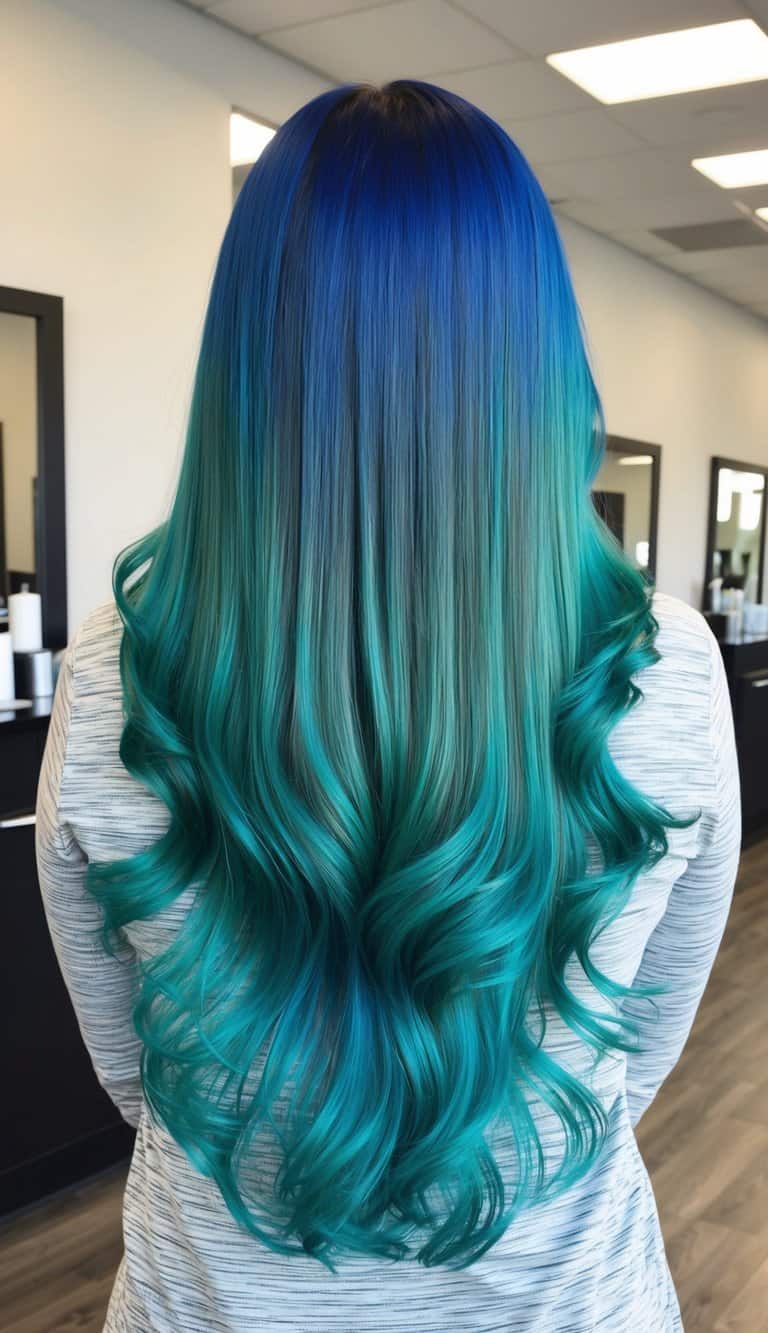
Prismatic pearl transition is one of the most technically complex and visually extraordinary entries in this collection — the teal ombre is overlaid with a prismatic, pearl-like quality that creates a color which appears to shift through multiple tones (teal, blue, green, and briefly violet) depending on the angle of light. The prismatic quality requires multiple tonal applications — teal as the base, with sections of blue and green applied over specific areas, and a pearl gloss that adds the opalescent shifting quality. The result is unlike standard ombre in its complexity and beauty.
Best for: Those who want the most technically ambitious and visually complex teal ombre result. Fair skin tones. Pre-lightened hair.
Color tip: This requires a colorist who specializes in creative color — the prismatic quality comes from precise placement of multiple tones, not a single-formula application.
19. Blissful Blue-Green Gradient

Blissful blue-green gradient is the most straightforwardly beautiful entry — a clean, clear gradient that moves from blue at the roots through teal in the mid-lengths to green at the ends, or vice versa, creating a color that spans the full blue-green spectrum of the teal family. The blissful quality comes from the satisfying, complete nature of the gradient — it doesn’t stop at teal but explores the full range, creating a color with narrative and movement. On long hair, this gradient can span multiple visible zones simultaneously.
Best for: All skin tones. Long hair where all three color zones can be simultaneously visible. Those who want to explore the full teal color family rather than a single tone.
Color tip: Apply blue at the top section, blend into teal in the middle, and blend into green at the ends — each application should overlap slightly at the boundaries to create seamless transitions between the three zones.
20. Verdant Voyage Ombre

Verdant voyage ombre leans furthest into the green territory within the teal family — verdant suggests lush, green vegetation rather than water, and this ombre reflects that shift. The color moves from a darker, more teal root through progressively more vivid green tones toward the ends, arriving at a lush, almost forest-green-adjacent tone that still retains enough teal blue to stay within the teal family. This is teal for those who love green — a nature-inspired, botanical interpretation of the color.
Best for: Warm and olive skin tones where the green complements warm complexions. Dark base hair where the green reads particularly rich and deep.
Color tip: A forest-green and teal dye mix at approximately 1:1 creates the verdant quality — the equal parts of each creates a perfectly balanced blue-green that reads as verdant rather than simply teal or simply green.
21. Celadine Shift Gradient

Celadine shift gradient takes its name from celandine — a wildflower with bright yellow-green color — and applies that yellow-green shift to the lighter end of a teal gradient. As the teal lightens toward the ends, it shifts subtly toward a warmer, yellow-green celadine tone rather than remaining purely teal. This warm-cool shift within the gradient creates an unusual and fascinating color — teal that becomes warmer and more botanical as it lightens, rather than simply paler and more aqua as standard teal gradients do.
Best for: Warm skin tones where the yellow-green shift complements warmth. Those who want an unusual, distinctive teal interpretation.
Color tip: Apply a yellow-green or chartreuse toner over the lightest, most pre-lightened sections at the ends while applying standard teal to the roots and mid-lengths — the warm end creates the celadine shift quality.
22. Alluring Algae Ombre

Alluring algae ombre is one of the most unusual and fashion-forward entries in this collection — algae green is a specific shade of deep, slightly muted blue-green that reads as organic and natural despite being obviously vivid. The algae quality comes from a slight desaturation and darkening of the teal tone, creating a color that has the depth and complexity of natural aquatic vegetation. Applied as an ombre from dark roots, alluring algae creates a color that’s dramatic, nature-inspired, and genuinely distinctive.
Best for: Cool and neutral skin tones. Dark base hair where the deep, muted teal reads particularly rich against the dark natural color.
Styling tip: Natural, effortless styling — air-dried texture, loose waves — suits the organic, nature-inspired quality of algae ombre better than sleek, polished looks.
23. Underwater Utopia Fade

Underwater utopia fade creates the most immersive and complete underwater color experience in this collection — the gradient moves through every tone of the underwater world, from deep teal-blue roots through mid-water aqua mid-lengths to pale, sunlit aqua-white tips. The utopia element suggests a perfect, idealized version of underwater color — each zone of the gradient is precisely the right tone, creating a color that appears to have been art-directed by an underwater photographer. The fade is exceptionally gradual, with each zone blending seamlessly into the next.
Best for: Fair to medium skin tones. Long hair where the complete underwater gradient can be appreciated. Pre-lightened hair for the palest, most accurate aqua-white tips.
Color tip: Three formulas — deep teal, standard teal, and a very diluted aqua — applied in sequence with careful blending at the boundaries creates the multizonal underwater gradient.
24. Lush Teal Ombre Waves with Dark Brown Roots

Lush teal ombre waves with dark brown roots is one of the most practical and wearable vivid color combinations — the dark brown roots are entirely natural-looking, requiring no bleaching or processing at the root, while the teal begins at the mid-lengths and intensifies toward the vivid, saturated ends. On wavy or curled hair, this combination creates a particularly beautiful effect as the waves alternate between dark brown and vivid teal, creating a dynamic color pattern that changes with every movement. The dark root also dramatically extends the time between salon visits.
Best for: Those with naturally dark brown hair who want vivid teal without processing the roots. All skin tones.
Maintenance tip: With dark roots, the only sections that require maintenance are the teal mid-lengths and ends — the roots grow in naturally and blend seamlessly with the existing dark section, effectively eliminating root maintenance entirely.
25. Dreamy Teal Ombre with Soft Waves

Dreamy teal ombre with soft waves pairs a soft, slightly pastel-leaning teal with loose, romantic wave styling to create a look that’s simultaneously vivid and gentle. The dreamy quality comes from both the softness of the teal tone (slightly diluted from full vivid intensity) and the relaxed, flowing quality of the wave styling — together they create a color and style combination that reads as effortlessly beautiful rather than obviously styled. This is one of the most universally flattering teal ombre presentations in the collection.
Best for: All skin tones. All face shapes — the soft waves flatter every face shape by adding softness and movement to the overall look. Medium to long hair.
Styling tip: Use a wide-barrel curling wand (32–40mm) to create loose, romantic waves, then gently brush through with fingers to soften the curls into the dreamy, flowing quality that defines this look.
26. Dark to Light Teal

Dark to light teal is the purest expression of the teal ombre concept — the color itself transitions from a deep, dark teal at the roots to a progressively lighter and brighter teal at the ends, without introducing any other color family. The gradient stays entirely within the teal spectrum, moving from the depths to the surface in a single, cohesive color journey. The result is a fully vivid look that has the dramatic impact of an all-over color with the dimension and movement of an ombre — the best of both approaches.
Best for: Those who are fully committed to vivid teal and want maximum impact. Fair to medium skin tones. Pre-lightened hair throughout for the clearest color expression.
Color tip: Achieve the dark-to-light effect within the teal family by mixing the same teal dye at different concentrations — full strength for the roots, 1:1 with conditioner for mid-lengths, 1:3 for ends — creating a perfectly matched gradient from dark to bright within the same hue.
27. Subtle Teal Ombre with a Soft Gradient
Subtle teal ombre with a soft gradient closes the collection with the most understated entry — a very gentle, barely-there teal that appears at the ends of otherwise natural-looking hair. The subtlety is genuine: without direct light, the teal quality can almost disappear, revealing itself clearly only when the hair moves into a bright patch of sunlight or direct illumination. This is the teal ombre for those who want a hint of something different — a secret color that reveals itself only when conditions are right.
Best for: Those new to vivid color who want to experiment cautiously. Professional settings where vivid color may not be appropriate in most lighting. All skin tones.
Color tip: Apply a heavily diluted teal dye (1:6 ratio with conditioner) to the last 2–3 inches of the hair only — the extreme dilution ensures the color reads as subtle in most lighting while still appearing when the light is right.
How to Achieve Teal Ombre Hair
- Pre-lighten for vibrancy: Teal is a direct dye that can only show its true color on a light base. For vivid results, hair must be lightened to at least level 9 (very light blonde). Darker bases produce darker, more muted teal results, which can be beautiful but won’t achieve the bright, aquatic quality of vivid teal.
- Choose your formulation: Teal comes in both semi-permanent direct dyes (deposit-only, fade gradually) and permanent options. For ombre, semi-permanent is usually recommended as it allows for gradual re-application and easier color changes as fashion evolves.
- Protect the color: Vivid hair colors are dramatically affected by heat, UV light, and frequent washing. Use heat protectant on every heat styling occasion, limit wash frequency to 2–3 times weekly, and use a color-specific shampoo without sulfates to extend the life of the teal.
- Expect regular maintenance: Vivid teal fades faster than natural-toned colors — typically 4–8 weeks before a noticeable shift toward aqua or blue-green. Budget for regular toning or refreshing appointments to maintain the intended color.
Frequently Asked Questions
How long does teal ombre hair last?
The vivid teal tone in ombre hair typically remains vibrant for 4–8 weeks, depending on hair porosity, wash frequency, water quality, and product use. High-porosity hair (bleached or chemically processed) holds direct dyes less effectively than low-porosity hair, while hard water and frequent washing dramatically accelerate fading. With careful maintenance, some teal ombres remain reasonably vibrant for 10–12 weeks before requiring a full refresh.
Can you get teal ombre on dark hair?
Yes, but the result depends on how much the hair is lightened first. On dark hair lightened to a medium blonde (level 7–8), teal produces a deeper, more forest-teal result that’s rich and beautiful but lacks the bright aqua quality of teal on near-white hair. On unlightened dark hair, teal direct dye has little to no visible effect. Most teal ombre looks that include any bright, vivid teal quality require at least medium-blonde lightening at the sections where the teal will be applied.
How do I stop teal hair from fading green?
Teal fades toward green (and then toward yellow-green) because the blue component of the dye fades faster than the green component. Slow this process by washing in cold water (heat opens the cuticle and accelerates fading), using a sulfate-free color shampoo, washing less frequently (dry shampoo between washes is a teal hair’s best friend), applying a UV protectant spray when outdoors, and refreshing the color with a blue-tinted toning conditioner to replace the blue component as it fades.
Final Thoughts
Teal ombre hair delivers the kind of visual impact that no natural hair color can achieve — a vivid, shifting, aquatic quality that draws the eye and creates conversation. The 27 ideas here demonstrate just how much creative range exists within the teal family, from the barely-perceptible cool mint fade to the fully committed daring depths teal, from the botanical verdant voyage to the celestial, otherworldly prismatic pearl transition.
Whatever the aesthetic goal and maintenance commitment level, teal ombre has an interpretation that fits. The technical requirements are real — pre-lightening, regular toning, careful product use — but the results are genuinely extraordinary for those willing to invest in them.


