26 Curly Hairstyle Ideas: Fresh Looks for Every Curl Type
Curly hair is one of nature’s most abundant and expressive gifts — a texture that creates volume, movement, and visual interest through its inherent structure rather than requiring any styling tool or product to achieve its characteristic beauty. Yet curly hair is also one of the most misunderstood and underserved hair types in mainstream styling culture: for decades, the dominant approach to curly hair was to straighten it, to manage it into submission, to treat its natural state as something to be corrected rather than celebrated. The contemporary curly hair movement has thoroughly reversed this perspective, establishing the understanding that curly hair is most beautiful when its natural pattern is supported, defined, and allowed to do what it naturally does.
These 26 curly hairstyle ideas celebrate the full range of what curly hair can achieve — from casual, effortless styles to formal updos, from defined ringlets to soft waves, from natural to colored, from short to long. Each idea demonstrates a different way to wear, style, or enhance curly hair’s unique qualities.
26 Curly Hairstyle Ideas
1. Voluminous Curly Lob

The voluminous curly lob pairs a lob (long bob) length with the natural volume of curly hair to create a style that reads as both modern and abundantly beautiful. The lob length is particularly flattering for curly hair because it’s long enough to allow the curl pattern to fully develop (very short curly hair can sometimes look compressed), but short enough to manage the volume and weight that very long curly hair can accumulate. The voluminous quality celebrates rather than contains the curly hair’s natural fullness — the styling prioritizes definition and moisture over smoothing or reducing the curl’s inherent expansiveness.
Best for: Medium curl patterns (2c–3b) where the curls have enough definition for a lob to show their shape clearly. Those who want modern, manageable curly hair with significant visual impact. Face shapes that benefit from width — the volume of a curly lob adds width at the cheeks and jaw.
Styling tip: Apply a curl cream through soaking wet hair section by section, scrunch upward, and diffuse on low heat until about 80% dry, then allow to air finish — this creates maximum definition with controlled volume.
2. Ombre Ringlets

Ombre color on tightly defined ringlets creates a visual effect that’s uniquely beautiful to curly hair — as each ringlet spirals from root to end, the ombre’s color transition from dark to light follows the curl’s own journey, creating a color reveal that’s literally embedded in the hair’s physical structure. On straight hair, ombre is a top-to-bottom transition; on ringlets, the same transition appears differently on every curl, with each coil showing the color change as it spirals. Viewed as a whole, ombre ringlets create an impression of luminosity and dimension that exceeds what the ombre technique achieves on any other hair type.
Best for: Tight to medium ringlet patterns (3a–4a) where each curl is clearly defined and the ombre transition is visible within individual curls. Any ombre color combination. Long to medium hair where the ringlets have room to fully coil.
Color tip: A warm ombre (dark brown to caramel or honey blonde) is the most naturalistic and broadly flattering choice for ringlets — the warmth echoes the natural sun-lightening pattern of tightly curled hair.
3. Bohemian Curly Ponytail

The bohemian curly ponytail takes the most practical of all hairstyles — the simple ponytail — and transforms it through curly hair’s natural expressiveness into something genuinely beautiful. The bohemian quality means the ponytail is worn loosely and with deliberate imperfection: flyaways are allowed, the base is gathered loosely rather than tightly, face-framing sections escape or are deliberately left out, and the overall effect reads as effortlessly natural rather than precisely groomed. On curly hair, this bohemian approach is particularly successful because the curl texture itself contributes to the organic, flowing quality of the style.
Best for: Most curly hair types and lengths. Casual to semi-formal occasions. Those who want the practicality of gathered hair with the beauty of displayed curls.
Styling tip: Gather the hair into a loose elastic at the nape or mid-height, then gently pull sections from the top forward to create volume at the crown and allowsome face-framing pieces to fall naturally — the looseness is what creates the bohemian quality.
4. Glossy Hollywood Curls

Glossy Hollywood curls reference the specific glamorous curl style of classic Hollywood — large, sweeping waves with a high-shine finish that reads as luxurious, polished, and deliberately beautiful. Unlike the more casual, naturalistic curls in this collection, Hollywood curls are a styled result rather than a simply enhanced natural one: the large barrel size, the directional setting of each curl, and the glossy finish all require intentional styling rather than product-and-diffuse simplicity. The result is a version of curly hair that’s associated with red-carpet glamour and classic beauty imagery — maximally flattering and elegantly dramatic.
Best for: Formal occasions, events, and special celebrations. Medium to long hair. All curl types — even naturally straight or wavy hair can achieve Hollywood curls with the right tools.
Styling tip: Set curls on a large barrel iron (1.5–2 inches), always curling away from the face, then allow to cool completely before releasing and gently running fingers through. Finish with a shine serum pressed over the surface for the glossy quality.
5. Textured Curly Layers

Textured curly layers describe a cutting and styling approach that maximizes the visual complexity and movement of curly hair through strategic layering. Layers in curly hair serve a different purpose than in straight hair: rather than simply adding movement to a flat surface, layers in curls remove weight that would otherwise pull the curl pattern down, allowing each layer to spring upward to its natural coiled height. The result is a style with multiple curl zones at different lengths, each group of curls springing to its own height and creating a visually rich, three-dimensional texture that single-length curly hair cannot achieve.
Best for: Medium to long curly hair where the layers can develop at meaningfully different lengths. All curl patterns — layering benefits both loose waves and tight coils by removing weight. Those who want maximum volume and definition simultaneously.
Cutting tip: Curly hair should be cut dry and in its natural state whenever possible — cutting wet creates imprecise results because the curl’s shrinkage changes the apparent length dramatically as it dries.
6. Braided Crown

A braided crown on curly hair creates a beautiful hybrid style — the structured, architectural quality of the braid at the crown contrasts with the free, organic curls that fall below or around it. The crown braid provides a neat, defined element that frames the face while the natural curls make the overall style feel alive and expressive rather than simply braided. The combination of braid and curl also creates a practical benefit: the braided crown keeps the front sections of the hair neat and face-free while allowing the back sections to display their natural curl pattern freely.
Best for: Medium to long curly hair where there’s sufficient length to braid at the crown. Semi-formal to formal occasions. Those who want the control of a partially up style with the expressiveness of displayed curls.
Styling tip: Apply a smoothing cream specifically to the crown sections before braiding to control any frizz in the braided element, while leaving the loose sections to dry with their natural curl-defining products.
7. Messy Curly Top Knot

The messy curly top knot is the quintessential effortless style for curly hair — a gathered bun at the crown that allows the curly hair’s natural tendency toward expansion and expressiveness to work in the style’s favor rather than against it. The messiness is intentional and functional: curly hair’s volume means a “perfect” bun would require significant effort and product; a deliberately loose and imperfect bun accepts the hair’s natural behavior and makes it part of the look. Tendrils and flyaways escape the bun and frame the face naturally, and the gathered mass at the crown creates a volume that straight hair simply cannot replicate in a top knot.
Best for: All curly hair types. Any occasion from the most casual to smart-casual events. Those who need hair out of their face. A go-to style for days when defined, down curls aren’t practical.
Styling tip: Gather all hair into a loose elastic at the very top of the head, then twist the length loosely around the base and secure with pins — the looser the gathering and twisting, the more natural and voluminous the knot appears.
8. Defined Curly Bob

A defined curly bob celebrates the specific beauty of tightly defined, clearly separated curls at a bob length — each curl is visible as its own distinct unit, the spaces between curls creating as much visual interest as the curls themselves. Definition in curly hair refers to the clarity with which each curl is delineated rather than merging with its neighbors into a mass of undefined texture. Achieving definition requires the right moisture-protein balance, appropriate styling products for the specific curl pattern, and a technique (scrunch, rake, or finger-coil) that encourages separation rather than clumping.
Best for: Bob cuts on medium to tight curl patterns (3a–4c) where definition is achievable and visually impactful. Those who prioritize clear, separated curls over volume. All occasions.
Styling tip: Apply a curl gel over a leave-in conditioner on soaking wet hair, rake through, then scrunch to encourage clumping. Once dry, break up the gel cast by scrunching with a small amount of oil — this reveals the definition while removing the crunch.
9. Bouncy Perm Style

The bouncy perm style brings curly texture to hair that might not naturally have it — or enhances existing curl patterns — through the permanent wave technique that creates consistent, bouncy curl all through the hair. Modern perm formulations are significantly more gentle and natural-looking than the tight, uniform curls of older perm techniques, creating results that can range from loose, beachy waves to defined, springy curls depending on the rod size and wrapping technique used. The bouncy quality specifically refers to a curl with significant spring and elasticity — curls that move and spring back when touched rather than hanging heavy.
Best for: Those without natural curl who want to add texture and movement. Those with existing curl who want to enhance and define their pattern. Medium to long hair where the bounce quality reads most dramatically.
Care tip: Permed hair requires the same care as naturally curly hair — sulfate-free shampoo, regular deep conditioning, and curl-specific styling products maintain the perm’s integrity and extend its life.
10. Half-Up Curly Bun

The half-up curly bun gathers the upper section of the hair into a bun at the crown while leaving the lower sections to fall freely in their natural curl pattern. This half-up approach is one of the most universally flattering hairstyles for curly hair: it controls the volume at the crown (which can read as too large without any management) while displaying the curl texture at the length, creates a clean face-framing effect without requiring all the hair to be gathered, and offers practical hair management without sacrificing the expressiveness of the natural curl pattern. The bun element can range from neat and precise to deliberately loose and voluminous depending on the desired formality.
Best for: All curly hair types and lengths. All occasions from casual to semi-formal. An excellent everyday style that manages volume without eliminating curl display.
Styling tip: Gather approximately the top third of the hair into the bun, leaving the remaining two-thirds to fall freely. The higher the gathering point, the more dramatic the crown volume; a lower gathering creates a more subtle, natural look.
11. Tousled Curly Lob
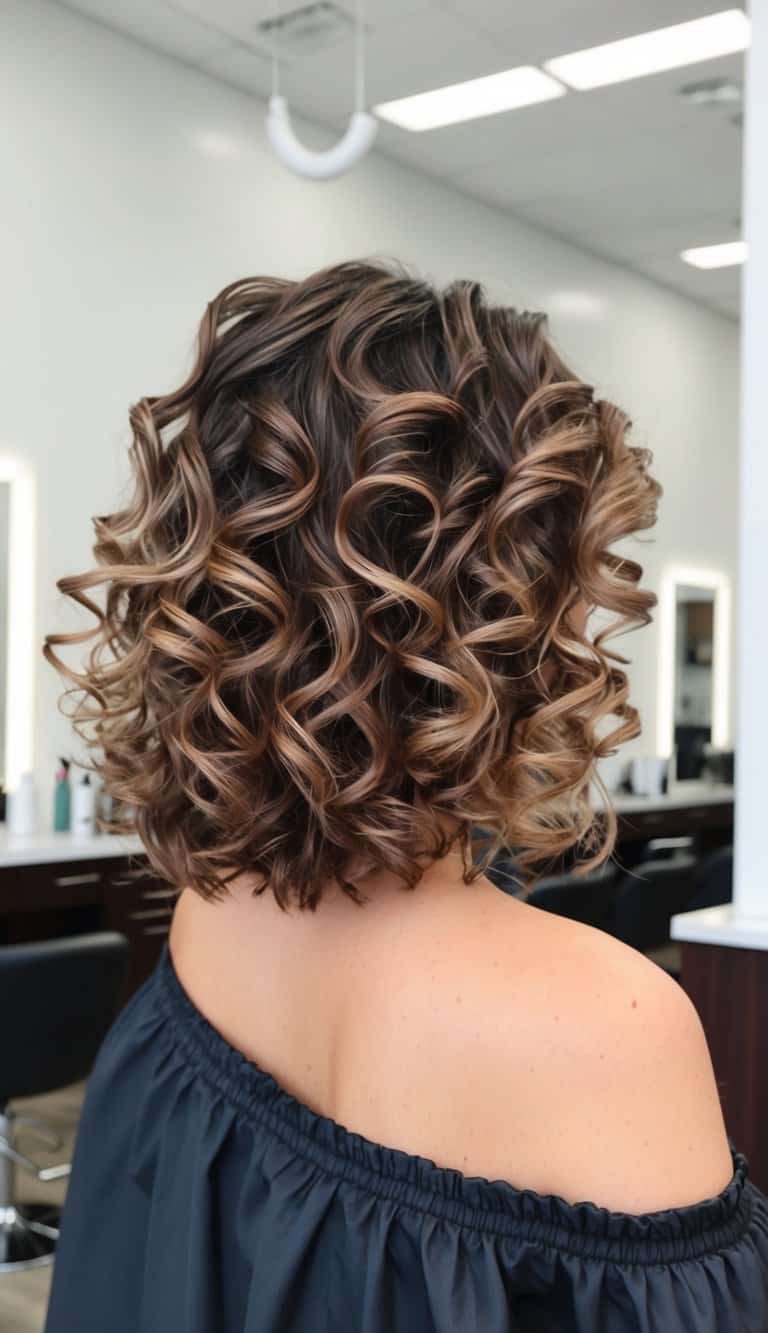
The tousled curly lob differs from the voluminous curly lob in its specific styling quality — tousled implies a deliberately undone, lived-in appearance where the curls have some definition but also some looseness, some separation but not clinical precision. The tousled quality comes from allowing the curls to partially dry then breaking them apart with fingers and a light oil, or from diffusing to definition and then scrunching and tossing the hair to loosen the pattern. The result reads as naturally beautiful and effortless in a way that perfectly defined, separated curls can sometimes miss — tousled curls look like hair that simply grows and dries beautifully without obsessive care.
Best for: Lob lengths on loose to medium curl patterns (2b–3b). Those who want natural-looking curls rather than highly defined ones. Casual to smart-casual occasions.
12. Curl-Pop Ponytail

The curl-pop ponytail is a styled ponytail designed to maximize the visual impact of the gathered curls — the “pop” refers to the way the curls spring and bounce from the elastic, creating a gathered tail that’s abundantly full and expressively curly rather than a smooth, subdued shape. Achieving a curl-pop ponytail typically involves stretching the roots slightly before gathering (to create height at the base), using a large, loose elastic rather than a tight band, and allowing the gathered curls to fall naturally rather than manipulating them into a specific shape. The gathered curls then express their natural bounce and volume without the weight of the full head pulling them down.
Best for: Medium to long curly hair with enough length to gather into a ponytail. All curl patterns. Casual to semi-formal occasions. Athletic contexts where a secure but expressive style is needed.
13. Soft Wispy Curls

Soft wispy curls are among the gentlest and most romantically beautiful of all curly styles — loose, barely-there spirals or waves with a light, airy quality that reads as delicate and feminine. The wispy quality comes from either naturally fine hair with a loose curl pattern (2a–2c) or from intentionally loosening tighter curls through stretching, finger-combing, or diffusing techniques that separate and elongate the pattern. Soft wispy curls frame the face with gentle movement rather than bold volume, creating a look that reads as soft and approachable.
Best for: Fine hair with loose wave or curl patterns. Those who want curly texture that reads as delicate rather than bold. Romantic occasions and casual everyday wear. Those who find tighter, more defined curls overwhelming for their face shape or personal aesthetic.
14. Quirky Curly Pigtails

Curly pigtails — two gathered sections of curly hair, one on each side — embrace the playful, expressive character of curly hair in a style that’s simultaneously practical and visually charming. The quirky quality suggests pigtails worn with a modern, fashion-forward sensibility rather than purely as a functional style — asymmetric placement, varied heights, intentional imperfection, or unusual gathering techniques all contribute to the quirky rather than conventionally cute quality of the look. Curly hair’s natural tendency toward expansion and expressiveness amplifies the visual impact of each pigtail, creating gathered sections that appear abundant and full.
Best for: All curly hair types and lengths. Casual and creative contexts. Those with a playful, expressive personal aesthetic. An excellent summer style that keeps hair off the face and neck while displaying the curl pattern beautifully.
15. Sassy Curly Undercut

A curly undercut combines the structural boldness of an undercut (shaved or very short sections beneath longer hair) with the expressive texture of natural curls at the longer sections above. The sassy quality describes the specific attitude of this combination — the contrast between the bold, deliberate undercut and the free-spirited natural curls creates a look of maximum individuality and confidence. The undercut also serves a practical function for thick, curly hair: removing volume at the nape and sides reduces the overall weight and bulk of the hair, allowing the remaining length to spring upward and outward rather than being dragged down by mass below.
Best for: Thick to medium curly hair where the undercut genuinely reduces bulk and increases the remaining curls’ volume and spring. Those with a bold, fashion-forward aesthetic. Those who want a distinctive cut that reads as genuinely individual.
16. Glamorous Curly Bob

The glamorous curly bob combines the classic appeal of the bob cut with the inherent expressiveness of curly hair and a deliberately glamorous styling approach — high shine, defined curl pattern, and a polished overall presentation that reads as dressed-up rather than casual. Where the defined curly bob focuses on curl separation and precision, the glamorous version prioritizes the overall visual impact of the full, lush bob shape: full volume, rich shine, and a sense of deliberate, confident beauty. A glossing spray or serum applied after styling creates the high-shine finish that elevates the look from simply curly to genuinely glamorous.
Best for: Bob lengths on medium to tight curl patterns. Formal and semi-formal occasions. Those who want their curly hair to read as maximally polished and put-together.
17. Sophisticated Curly Updo

A sophisticated curly updo uses the natural texture and volume of curly hair to create an upswept style that reads as elegant and deliberately beautiful — a step beyond the casual bun or simple ponytail, with the curls used as decorative elements in the construction of the updo rather than simply being contained within it. The sophisticated quality comes from intentional arrangement: loose curls are pinned in specific positions to create visual interest, tendrils are allowed to escape at the temples and nape to soften the overall shape, and the overall construction balances the formal quality of an updo with the natural expressiveness of curly texture.
Best for: Formal occasions — weddings, galas, and formal events. Medium to long curly hair. All curl patterns, though looser curls (2c–3b) are easiest to arrange in updo constructions.
Styling tip: Work on hair that is approximately 80% dry and fully product-set — completely dry hair is harder to manipulate, while damp hair can cause the updo to shift as it finishes drying.
18. Classic Curly Pageboy

The curly pageboy references the classic pageboy cut — a short to medium length with a rounded shape and often a fringe — executed in curly hair, where the natural texture transforms the cut’s classic character into something more dynamic and expressive. The pageboy’s rounded shape is naturally mimicked by curly hair’s tendency to expand outward and spring upward from the cut line, creating the characteristic rounded silhouette of the style organically rather than through blowdrying and brushing. The classic quality suggests a precisely executed version of the cut — the fringe crisp, the length even, the curls well-defined — rather than a deliberately undone interpretation.
Best for: Short to medium curl patterns where the pageboy length (chin to jaw) works best. Those who want a structured, classic cut with curly texture. All occasions.
19. Twisted Curl Accent

The twisted curl accent uses a small section of twisted hair — typically a two-strand twist at the hairline or temple — as a decorative element within an otherwise loose curly style. The twist creates a structured, defined accent that contrasts with the free-flowing curls of the main style, drawing attention to the face-framing area and adding a deliberate, considered element to what might otherwise be a simple wear-curls-down look. Two-strand twists create a specific textural pattern (a rope-like spiral) that’s distinct from both single-strand curls and braids, adding variety to the overall style’s textural story.
Best for: All curly hair types. Any length where face-framing sections can be twisted. Casual to semi-formal occasions. An excellent way to elevate a simple down-curls style with minimal effort.
20. Braided Ponytail

A braided ponytail on curly hair creates a style that displays two different textural approaches simultaneously — the structured, linear pattern of the braid contrasts with the free, spiraling pattern of any curls not incorporated into the braid, or the braid tail contrasts with the curly sections left loose around the face. The combination of braiding and curly texture creates a style that reads as more intentional and complex than either element alone, with the braid providing structure and the curls providing organic expressiveness. Braiding curly hair also gently stretches the curl pattern, creating a slightly different texture in the braided sections that reveals when the braid is unraveled.
Best for: All curly hair types with sufficient length to braid. All occasions. A practical style that manages curly hair while displaying both its ability to be structured (the braid) and its natural expressiveness (any free sections).
21. Face-Framing Tendrils

Face-framing tendrils are the specific styling choice of allowing or encouraging small, defined curl sections to fall forward around the face while the rest of the hair is gathered or worn back. The tendrils create a softening effect at the hairline — the face is framed by delicate, defined spirals rather than having a hard line between face and hair — that reads as both romantic and deliberately considered. For curly hair, face-framing tendrils often happen naturally; the art is in styling them to be specifically defined and beautifully shaped rather than simply flyaways that escaped a style.
Best for: Any gathered or upswept curly style where face-framing sections can be left free. All curl patterns. Formal and romantic occasions where the softening effect of tendrils is most appropriate.
Styling tip: Apply a small amount of curl cream specifically to the face-framing sections and finger-coil them into tight spirals, then allow to set before gathering the rest of the hair — this ensures the tendrils are defined and intentional rather than simply escaped flyaways.
22. Highlighted Chin-Length Layers

Highlighted chin-length layers on curly hair combine three distinct elements — the color dimension of highlights, the structural movement of layers, and the specific length of chin-level styling — to create a look of considerable visual richness. At chin length, curly hair’s volume is concentrated in the most face-adjacent zone, making the highlights most visible and impactful. The layers add movement and prevent the volume from reading as a single mass, while the highlights add color dimension that reads differently within the curly texture than in straight hair — the color appears and disappears within the curl pattern as the hair moves, creating a dynamic color reveal.
Best for: Chin-length curly cuts. Medium curl patterns where layers are most visible. Any warm highlight color. Those who want the maximum visual complexity from their curly style.
23. Sun-Kissed Curls

Sun-kissed curls describe a color and texture combination that reads as naturally beautiful and organically achieved — the specific lightening of curly hair’s surface sections (as sunlight naturally lightens the most exposed sections of any hair type) combined with the free-spirited expressiveness of naturally worn curls. The sun-kissed color quality is a warm, golden lightening of the outermost, most light-catching sections of the curly hair while the under-sections remain darker, creating a naturally multidimensional color that looks like it might genuinely have developed over a summer outdoors. The curls are styled to read as natural and relaxed rather than processed or perfected.
Best for: Natural brunettes and warm-toned hair where sun-kissed highlights are most naturalistic. All curl patterns. Those who want a color enhancement that reads as completely natural. All hair lengths.
24. Ombre Curly Locks

Ombre curly locks display the ombre color technique on long, well-defined curls — the root-to-tip color transition follows the full length of the curls as they spiral downward, creating a color journey that’s uniquely beautiful on long, defined curly hair. As each curl spirals from its attachment point to its tip, it traces the entire ombre from dark to light in miniature, creating a color story that’s literally three-dimensional. Long ombre curly hair is one of the most visually abundant and expressive hairstyles available — the combination of color variation, curl texture, and length creates a look of almost extraordinary beauty.
Best for: Long curly hair where the ombre has maximum length to develop. Tight to medium ringlet patterns where each curl shows the ombre transition clearly. Any ombre color combination.
25. Caramel Curly Bob

A caramel-colored curly bob combines the warm, golden-brown richness of caramel color with the volume and expressiveness of a curly bob cut. Caramel is one of the most universally flattering hair colors across different skin tones, adding warmth and luminosity without the sometimes-harsh clarity of lighter blonde shades. On curly hair, caramel reads particularly beautifully — the color’s warmth catches the light within the curl pattern, creating areas of brilliant golden-caramel brilliance as the curls move and catch the light at different angles. The bob length concentrates this warm color in the most visible, face-adjacent zone of the hair.
Best for: Warm to neutral skin tones where caramel’s warmth is most flattering. Bob cuts on medium to tight curl patterns. Those who want a warm, luminous color with the versatility of bob styling.
26. Twisted Curls

Twisted curls use the two-strand twist styling technique as a way of defining and organizing the natural curl pattern — each section of hair is divided into two and twisted around itself, creating a rope-like structure that, when allowed to set and then unraveled, produces a defined, uniform curl pattern with a specific texture distinct from both natural curls and braids. Twist-outs (the unraveled result of two-strand twists) are among the most popular curl-defining techniques for natural hair, particularly for tighter coil patterns where product-and-diffuse styling may not create sufficient definition. The twisted curls result reads as intentionally defined without appearing over-manipulated or artificially uniform.
Best for: Natural and textured hair, particularly type 4 coil patterns where other defining techniques may not achieve visible curl definition. All hair lengths. A versatile technique that can be worn as the twist itself (for a more structured look) or as the unraveled twist-out (for defined, bouncy curls).
Technique tip: Apply a twisting butter or cream to each section on damp hair before twisting, allow to dry completely (or sit overnight), then unravel each twist carefully and separate gently with oiled fingers to maximize definition without frizz.
Essential Tips for Curly Hair Care
- Moisture is foundational: Curly hair’s structure means natural scalp oils travel down the shaft less efficiently than in straight hair — moisture must be actively supplied through leave-in conditioners, curl creams, and regular deep conditioning treatments.
- Detangle wet with conditioner: Never dry-detangle curly hair — always detangle with fingers or a wide-tooth comb in the shower with conditioner coating the hair, working from tips to roots to minimize breakage.
- Product layering matters: The curly hair method typically layers a leave-in conditioner (moisture), a cream (definition), and a gel (hold) in that order over wet hair — each product builds on the last to create a moisture-definition-hold system that maintains the curl through drying.
- Protect at night: Sleep on a silk or satin pillowcase or in a silk bonnet — cotton pillowcases cause friction that disrupts curl patterns and creates frizz overnight.
- Avoid touching while drying: Curls form most clearly when left completely undisturbed as they dry — touching, scrunching, or manipulating curls as they dry disrupts the forming gel cast and creates frizz.
Frequently Asked Questions
What products work best for curly hair?
The best curly hair products depend on your specific curl pattern, hair porosity, and styling goals. Generally, the layering system of leave-in conditioner + curl cream + gel works across most curl types. Those with fine or low-porosity curls should use lighter formulas to avoid weighing curls down; those with thick or high-porosity curls can use richer creams and stronger gels for more definition and hold.
How often should curly hair be washed?
Curly hair is typically washed less frequently than straight hair — the curl structure means it dries more slowly and doesn’t become oily as quickly. Most curly-haired people wash once or twice weekly, refreshing between washes with water and a light conditioner or curl refresher spray. Co-washing (washing with conditioner instead of shampoo) between regular wash days maintains moisture without stripping the hair’s natural oils.
How do I reduce frizz in curly hair?
Frizz is primarily caused by lack of moisture — curly hair lifts its cuticle in search of environmental humidity. The best frizz prevention is thorough moisture: deep conditioning regularly, applying products on soaking wet hair (which seals moisture into the cuticle), using an anti-humidity gel or cream, drying with a microfiber towel or t-shirt (not a regular towel, which creates friction), and sleeping on silk.
Final Thoughts
Curly hair’s extraordinary range — from the softest waves to the tightest coils, from casual effortlessness to formal glamour — makes it one of the most versatile and expressive of all hair types when properly understood and cared for. The 26 styles in this collection represent just a portion of what curly hair can achieve, each demonstrating a different facet of the texture’s unique beauty. Whether your curls are natural or styled, loose or tight, short or long, the most important curly hair principle remains the same: work with the texture rather than against it, and the results will always be more beautiful.


