22 Black to Gray Ombre Ideas: Cool and Edgy Hairstyles for a Modern Look
Black to gray ombre hair occupies a uniquely sophisticated space in the color spectrum — it works with the natural chemistry of dark hair and the inherent elegance of gray to create transitions that feel simultaneously intentional and organic. Unlike the warm, vivid ombre palettes that draw from fire and sunlight, the black to gray ombre draws from shadow, smoke, mist, and stone. The result is a color family that reads as cool, modern, and undeniably chic — a departure from conventional hair color that makes a clear, confident statement about aesthetic preference. Gray, once a color that many rushed to cover, has become one of the most sought-after tones in contemporary hair coloring, and nowhere is it more dramatic and beautiful than in contrast with deep, rich black.
These 22 black to gray ombre ideas explore the full range of the black-to-gray transition — from the subtlest, most barely-there gray whispers to the most dramatically contrasting silver-and-black statements.
22 Black to Gray Ombre Hair Ideas
1. Charcoal Frost Fade

The charcoal frost fade occupies a specific tonal zone between true black and cool gray — charcoal is the color of burnt wood, darker and warmer than pure gray but distinctly cooler and more complex than standard dark brown. In a fade ombre, the charcoal transitions gradually and smoothly from deep black at the roots through progressively lighter charcoal gray toward the ends, with the frost quality indicating a particularly pale, cool-toned end result that approaches silver. The fade technique creates a seamless, gradual transition without a defined color line, producing an ombre that reads as natural and organic rather than deliberately dyed.
Best for: Naturally dark hair where the charcoal tones develop beautifully without requiring significant lightening. Cool skin tones where the charcoal and frost gray complement the complexion’s natural undertones. Those who want a subtle gray ombre that’s clearly fashion-forward without being dramatically vivid.
Styling tip: Sleek, straight styling best showcases the fade quality by keeping the color gradient smooth and uninterrupted — waves and texture can visually break up the gradient, reducing the impact of the seamless fade.
2. Graphite Whisper Ombre

The graphite whisper is the most restrained, barely-there interpretation of the black to gray ombre — graphite is a dark gray that’s only slightly lighter than black, and the whisper quality suggests this is a color that’s almost subliminal, visible only in certain light or at certain angles rather than immediately obvious from across a room. The graphite whisper ombre is for those who want the cool, sophisticated quality of a gray ombre without the obviousness of a dramatic color change — it’s the “for those who know” option in the black to gray collection, noticed and appreciated by those who look closely. In direct sunlight or photography, the graphite quality becomes clearly visible; in everyday indoor light, the hair reads as a very complex, dimensional dark.
Best for: Professional environments where dramatic color changes may be inappropriate. Those with dark hair who want to explore gray tones without committing to a visible color statement. Cool and neutral skin tones where graphite’s cool-leaning quality reads most elegantly.
Color tip: A graphite whisper requires minimal lightening — in many cases, a toning treatment alone can add the gray-cool quality to naturally dark hair without a lightening step.
3. Obsidian Cascade

Obsidian is volcanic glass — the deepest, most intensely black natural substance — and the obsidian cascade ombre uses this quality to describe a look where the black at the roots is as deep and as richly saturated as it can possibly be, creating maximum contrast with the gray that develops toward the ends. The cascade quality suggests the gray is revealed gradually from top to bottom, like water cascading down a dark cliff face: the black is dominant and the gray appears as the eye travels downward. The intensity of the black at the root makes the gray transition more dramatic and impactful than in ombres where the root is a more ordinary dark.
Best for: Those who want the maximum drama of black-to-gray contrast. Long hair where the cascade effect has the most visible length to develop. Cool skin tones where the deep black root creates a stunning, high-contrast look.
Color tip: To achieve obsidian-quality black at the roots, use a blue-black formula rather than a neutral or warm black — the blue undertones in blue-black create the deepest, most saturated color that contrasts most dramatically with gray ends.
4. Black to Warm Gray

The black to warm gray ombre takes the typically cool, blue-tinged quality of gray and adds warmth — the gray at the ends has a slight taupe, greige, or mushroom quality rather than the steely cool of classic gray. This warm gray is more approachable and wearable for warm and neutral skin tones than cool silver-gray, and it creates a transition that feels more natural and organic, as though the black has simply warmed and faded rather than been intentionally colored. The black to warm gray combination is one of the most universally flattering ombres in the collection precisely because its warmth adapts to a wider range of skin tone undertones.
Best for: Warm and neutral skin tones where warm gray reads more harmoniously than cool silver. Those who find cool gray too stark or unflattering but love the gray ombre concept. Dark hair bases where the warm gray develops naturally during the lightening and toning process.
Color tip: A toner with slight beige or taupe undertones (rather than violet or blue) creates the warm gray quality — mushroom, greige, and warm silver toners are the specific formulas to request.
5. Deep Black to Misty Veil

The misty veil describes gray at its most ethereal and diffuse — not the crisp, high-contrast silver of a dramatic gray ombre but rather a soft, slightly blurred gray that appears as though a fine mist has settled on the ends of the hair. The mist quality is created through a particularly soft transition technique (heavy feathering, extensive blending) and through specific toning that leaves the gray with a slightly diffused, washed-out quality rather than a saturated, precise color. The deep black root intensifies the misty quality of the ends by providing the contrast that makes the softness of the gray most visible.
Best for: Those who want a soft, romantic gray ombre rather than a graphic or dramatic one. Medium to long hair where the misty quality has length to develop. Cool skin tones where the soft gray is particularly luminous and flattering.
Styling tip: Loose, soft waves enhance the misty quality — the slight blur of a wave at the ends amplifies the diffused, ethereal quality of the misty veil color. Avoid sleek, straight styling, which makes the misty quality look flat rather than atmospheric.
6. Nightshade Ombre Style

Nightshade is a deeply moody, blue-black that transitions into a cool, slightly purple-tinged gray — the name references the dark, mysterious plant whose berries carry a deep, complex blue-black color. In ombre form, the nightshade quality suggests a color with depth and intrigue rather than simple darkness: the black has a subtle blue or violet undertone that’s most visible in bright light, and the gray it transitions into carries a matching cool-violet quality that keeps the overall look visually cohesive. Nightshade ombre is among the most editorial and fashion-forward looks in the black to gray collection.
Best for: Those who want their gray ombre to have an additional dimension of cool, violet-adjacent color. Cool and very cool skin tones where blue-violet undertones are most flattering. Those with an avant-garde aesthetic who want their hair to be distinctly bold.
Color tip: A violet-tinted black at the root and a lavender-gray toner at the ends (rather than purely neutral gray) creates the nightshade quality — the matching violet undertone in both root and end colors is what makes the look cohesive.
7. Velvet Noir to Gray Tint
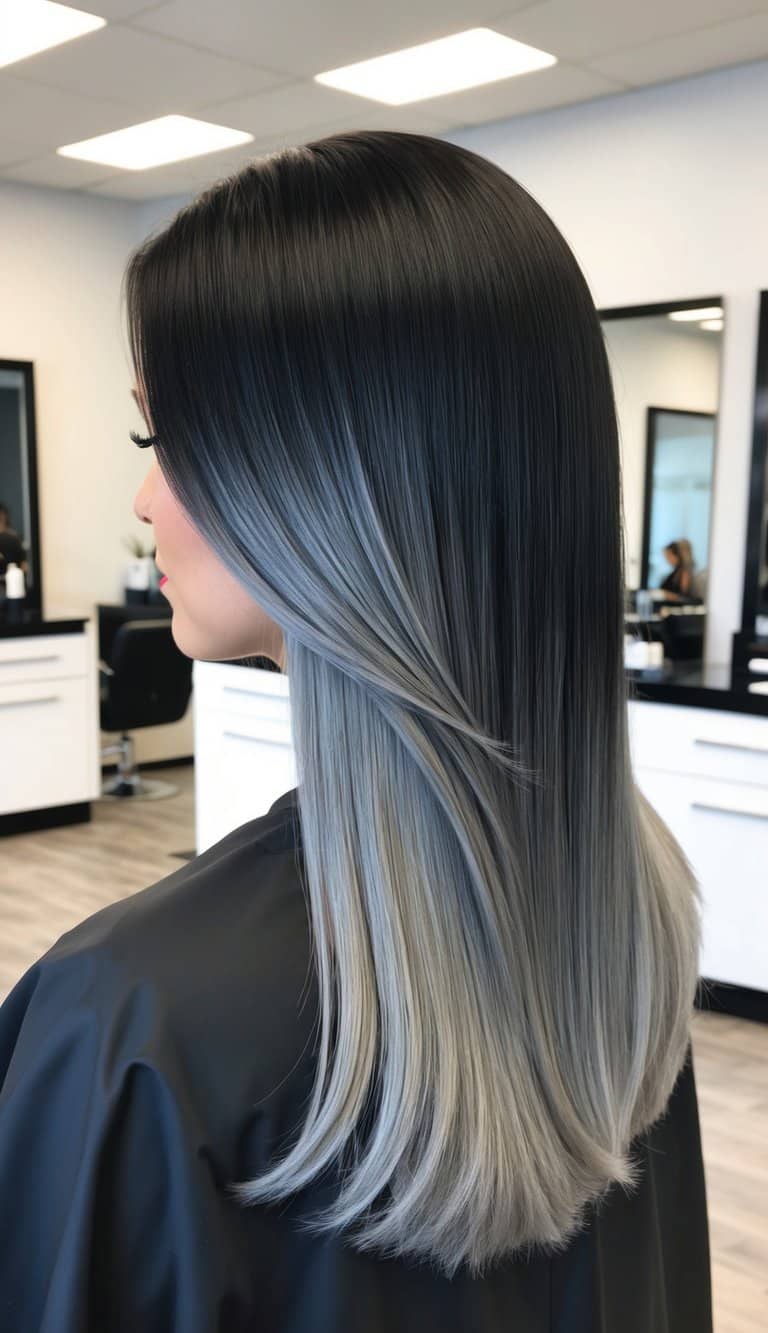
Velvet noir describes a specific quality of black hair — the lush, light-absorbing softness of velvet fabric applied to the darkest possible hair color, creating a black that feels tactile and warm rather than hard and flat. The velvet quality comes from the color’s depth and the hair’s condition: well-maintained, deeply pigmented black hair has a softness that reads as genuinely velvet-like. The gray tint at the ends is intentionally subtle — a hint of cool gray rather than a full gray ombre — keeping the overall look dramatically dark with just a suggestion of the sophisticated gray transition at the very tips. This is the most understated of the gray ombres, the deepest, most noir-influenced look in the collection.
Best for: Those who love the depth and drama of dark hair but want a subtle, sophisticated modern update. Cool skin tones with high contrast between hair and skin. Those who want their gray ombre to be visible primarily at close range or in photographs.
Color tip: The velvet quality of the black is maintained by using a blue-black permanent color and finishing with a gloss treatment — the gloss seals the cuticle and creates the smooth, light-absorbing surface that gives black hair its velvet quality.
8. Eclipse to Gentle Gray

The eclipse references the astronomical event where the moon passes between earth and sun, creating a black disc surrounded by a corona of silver-white light — and this ombre translates that specific visual quality into hair, with deep black dominating the length and a gentle, soft gray appearing at the very ends like the corona surrounding the eclipse. The “gentle” quality is important: this gray is not dramatic or high-contrast but rather soft and gradual, appearing as a natural softening of the black rather than a distinct color change. The eclipse-to-gentle gray ombre is one of the most natural-looking transitions in the collection.
Best for: Those who want the gray ombre to appear natural, as though the hair is simply fading or lightening naturally at the ends. Most skin tones. Long to medium hair where the gentle transition has enough length to develop subtly.
Styling tip: Natural air-drying with minimal product suits this look most — the gentle, natural-looking transition is best complemented by styling that also looks uncontrived and organic.
9. Black to Pale Gray

Black to pale gray is one of the most dramatically contrasting and visually impactful ombres in the collection — the pale gray end result requires significant lightening of the base black hair to reach the near-white gray level, creating a maximum contrast between the deep root and the pale, almost white ends. The result is a graphic, high-impact ombre that reads as genuinely striking and unmistakably intentional. The pale gray at the ends can be toned to a precise cool silver, a soft lavender-gray, or a warm champagne-gray depending on the specific effect desired, with each toner choice creating a distinct variation within the black-to-pale-gray concept.
Best for: Those who want maximum visual impact from their black to gray ombre. Cool skin tones where the high-contrast black and pale gray look most striking. Long hair where the dramatic contrast has the most length to develop and be appreciated.
Maintenance note: Pale gray requires the most frequent maintenance of any look in this collection — toning every 6–8 weeks and purple shampoo twice weekly are both essential to maintain the pale, cool quality and prevent the ends from yellowing or developing warm tones.
10. Black to Stormy Gray

Stormy gray is a specific mid-tone gray — darker and more complex than pale silver but lighter than charcoal, with a slightly blue-dark quality that evokes the color of storm clouds before rain. In a black to stormy gray ombre, the transition arrives at this dramatic, sky-referencing mid-gray rather than pushing all the way to a pale silver, creating a result that’s less contrast-focused and more tonally interesting — the stormy gray has its own depth and complexity that makes it as interesting as the black root it transitions from. The look is inherently dramatic and moody, with strong associations with editorial and avant-garde aesthetics.
Best for: Those who want a gray ombre with a moody, atmospheric quality rather than a clean, graphic contrast. Cool and neutral skin tones. Medium to long hair where the stormy gray develops at a dramatically visible mid-point of the length.
Color tip: A steel gray or slate blue-gray toner creates the stormy quality — avoid toners that pull too violet (which creates a lavender gray) or too warm (which creates a taupe-gray), as neither captures the specific blue-cool atmosphere of true storm gray.
11. Black Coffee Fade

The black coffee fade introduces a warm, slightly brown quality to the black base — black coffee has a specific richness and warmth that distinguishes it from pure neutral black, with the warm brown undertones of coffee visible in strong light. This warm-leaning black transitions into a gray that also carries slight warmth (a greige or warm silver), creating a black-to-gray ombre with internal warmth throughout rather than the stark coolness of pure black-to-silver. The coffee quality makes this ombre particularly accessible and wearable for those with warm skin tones who find cool black-to-silver combinations too stark.
Best for: Warm and neutral skin tones. Those with naturally warm or reddish-brown dark hair where the coffee quality develops naturally. Those who love the gray ombre trend but find pure cool-toned versions unflattering.
Styling tip: Loose, casual waves suit the coffee fade quality most authentically — the slightly undone, natural quality of beach waves complements the organic, lived-in aesthetic of this warm-toned ombre.
12. Moody Ombre

The moody ombre is defined by its atmospheric, emotional quality — this is not a clean, graphic color statement but rather a brooding, complex color story where the black and gray blend in a way that feels heavy with mood and intention. The moodiness comes from the specific tonal range chosen (never too pale, always maintaining significant darkness throughout), the blending technique (soft and gradual, with no clear transition point), and the specific gray tones used (always cool, always complex, never bright or vivid). A moody ombre reads as deeply fashionable and slightly mysterious — the color equivalent of a perfectly composed black-and-white photograph.
Best for: Those with a strong, defined aesthetic who want their hair to reinforce rather than contradict their overall style direction. Cool skin tones. All lengths, though medium to long hair has the most space for the moody quality to develop fully.
Styling tip: Second-day or texturized hair suits the moody ombre most — the slight imperfection of undone texture amplifies the brooding, effortlessly cool quality of the moody color story.
13. Inky Depth to Light Haze

Inky depth to light haze creates one of the most poetically beautiful contrasts in the black to gray collection — the inky quality of the root (the intensely saturated, almost liquid-dark black) transitioning to a light haze (the barely-there, atmospheric gray at the ends that reads more as diffused light than as specific color). The distance between these two qualities is the look’s central drama: the saturated and the barely-there, the heavy and the weightless, the dark and the luminous. In movement, the inky roots and the light haze ends are both visible simultaneously, creating a dynamic, constantly shifting color story.
Best for: Long hair where the contrast between root and end has maximum length to develop. Cool skin tones. Those who want their black to gray ombre to have a poetic, atmospheric quality rather than a graphic or technical one.
Color tip: The inky depth requires a blue-black formula at the root; the light haze requires a high-lift with very precise toning to a barely-there gray that doesn’t pull blue or violet. The specific pairing of the two extremes is what creates this look’s distinctive quality.
14. Dusk to Dawn Transition

The dusk to dawn transition references the specific quality of light at the day’s twilight edges — the deep, dusky darkness that precedes night transitioning toward the pale, cool light of dawn. In hair, this translates as a black root (the dusk) gradually transitioning through dark charcoal, medium gray, and finally to a pale, dawn-light gray at the very tips. The transition captures the full spectrum of the black-to-gray range within a single look, moving through multiple intermediate tones rather than jumping directly from black to a single gray destination. The multiple-tone approach creates a more complex and refined ombre than a simple two-color gradient.
Best for: Long hair where multiple transition tones have space to develop between root and end. Cool skin tones. Those who want a particularly sophisticated, multi-dimensional ombre that repays close attention with its tonal complexity.
Color tip: A multi-tonal approach requires planning: the root is set at blue-black, then the hair is lifted in stages, with a different toner applied at each level to create the distinct dark charcoal, medium gray, and pale dawn transitions rather than a single uniform lift.
15. Charred Ash Gradient

Charred ash gradient references the color of wood after fire — the specific gray-black of ash that retains some of the warmth of the charring process while moving toward the cool gray of fully burned material. In hair terms, the charred quality at the root is a very dark, slightly warm-black, transitioning through a mid-ash gray to a cool, pale ash at the ends. The ash quality throughout the gradient is important — ash tones have a specific cool, slightly muted quality that distinguishes them from other grays. The charred ash gradient is one of the most textural and richly descriptive looks in the collection, with a quality that feels genuinely dimensional and complex.
Best for: Neutral to cool skin tones where ash tones complement rather than wash out the complexion. Medium to long hair. Those who want a gray ombre that reads as natural and organic rather than artificially colored.
Color tip: Ash tones require the correct underlying tone in the lightened base — too much yellow in the lifted hair will fight the ash toner and create a green-gray result. A clean, neutral lift is essential before applying ash tones.
16. Phantom Black Shift

Phantom black describes a quality of black that’s not quite solid — it has an elusive, shifting quality, appearing as deep black from one angle and as dark gray from another. The phantom quality comes from the specific lightening and toning technique: rather than a uniform black base, the root has subtle variation that creates the phantom effect. The shift refers to the gradual move from this complex phantom black into a clearer, more conventional gray toward the ends. The phantom black shift ombre is one of the most technically nuanced looks in the collection — its beauty is in the subtlety of the root variation as much as in the ombre transition.
Best for: Those who appreciate technical hairstyling nuance and want a look that rewards careful observation. Cool skin tones. Those who want a black-to-gray ombre where the black is as interesting and complex as the gray.
Styling tip: Direct sunlight or strong directional indoor light best reveals the phantom quality of the root — in flat, diffuse lighting, the subtlety of the root variation is less visible, and the look reads more as a standard black.
17. Edgy Twist

The edgy twist introduces a cut and styling element alongside the color — this is a black to gray ombre on a haircut with an intentional edge: an undercut, an asymmetrical cut, a dramatic textured bob, or another cut that reinforces the bold, fashion-forward quality of the black to gray color. The combination of edgy cut and cool ombre color creates a look that’s more than the sum of its parts — each element amplifies the other’s impact, the ombre making the cut more visually interesting and the cut giving the ombre a directional, fashion-forward context. This is the black to gray ombre for those who want their overall look to make a strong, confident statement.
Best for: Those with a bold, fashion-forward personal aesthetic. Shorter to medium lengths where the cut and color can be appreciated together without one obscuring the other. Cool skin tones. Those who want their color and cut to work as a coordinated, unified statement.
Styling tip: The edgy quality of both cut and color is most impactful with minimal, texture-forward styling — a matte paste or sea salt spray that emphasizes the cut’s architectural qualities rather than smoothing or softening them.
18. Dark Veil to Pearl

Dark veil to pearl is one of the most romantically beautiful and poetically named black to gray ombres — the dark veil quality of the root (a sheer, gossamer black that has a slight translucency rather than a solid opacity) transitioning to the pearl quality of the ends (a soft, luminous, slightly warm white-gray that has the specific glow of a pearl’s nacre). The pearl at the end is distinct from a standard pale gray — it has a slight warmth and luminosity that references the specific quality of real pearls, a color that glows gently rather than simply reflecting light. The combination of veil black and pearl gray is among the most luxurious and considered in the collection.
Best for: Long hair. Neutral to cool skin tones. Formal occasions where a particularly beautiful, considered color is appropriate. Those who want a black to gray ombre with a distinctly feminine and elegant character.
Color tip: Pearl gray requires a specific toner — a slightly warm silver with barely-there beige undertones, not a cool blue-silver. The warmth is what creates the glow quality that distinguishes pearl from standard pale gray.
19. Smoky Quartz Illusion

Smoky quartz is a semi-precious stone with a specific translucent brown-gray quality — it’s not a flat gray but a multi-dimensional gray-brown with depth and an almost crystalline internal variation. In hair color, the smoky quartz quality is achieved through layered toning that creates a brown-gray result with visible warmth beneath a cool surface — the color appears to shift between warm and cool depending on the light source and angle, creating the “illusion” quality referenced in the name. This is a particularly sophisticated and nuanced gray that reads as complex and considered rather than simply gray.
Best for: Those who find pure cool gray too stark but warm gray too simple — smoky quartz occupies the precise middle territory between the two. Neutral to warm skin tones where the brown-gray reads most harmoniously. Those who want their gray ombre to have an almost gemstone-like quality and complexity.
Color tip: A warm brown base with a cool gray toner applied at the ends creates the smoky quartz effect — the warm base shows through the cool gray toner as the two interact, creating the brown-gray, multi-dimensional quality of the stone.
20. Dramatic Gray

Dramatic gray is the most overtly impactful and immediately striking look in the collection — it doesn’t try to be subtle, natural, or understated. Instead, it embraces the maximum possible contrast between a rich, deep black root and a fully saturated, vivid gray end, creating a black to gray ombre that reads as a bold, intentional color statement from across a room. The dramatic quality comes from the clarity and saturation of both the black and the gray — the black is as dark as it can be, and the gray is as clearly, purely gray as it can be, with no muddying warmth or excessive toning complexity blurring the clean contrast between them.
Best for: Those with a bold, confident aesthetic who want their hair to be unmistakable. Long hair where the dramatic contrast has maximum impact. Cool skin tones where the high-contrast black and silver gray look most striking and complementary.
Maintenance tip: The most vivid, saturated gray tones require the most frequent maintenance — plan for toning appointments every 6–8 weeks to maintain the saturation and the specific gray tone as it fades.
21. Shadow Satin Gradient

Shadow satin gradient describes a black to gray ombre with a particularly smooth, high-shine surface quality — the satin quality means the color is presented on hair with exceptional condition and a reflective, slightly sheen-forward finish rather than a matte or textured surface. The shadow quality of the black has a slight depth and complexity, and the satin surface makes both the black and the gray appear to glow with their own internal light. The gradient refers to the particularly smooth, precise transition between the two tones, with no harsh or sudden color shift visible anywhere along the length. This is the most technically polished look in the collection.
Best for: Straight to slightly wavy hair where the satin surface quality is most visible and impressive. Those who prioritize hair condition and shine as much as color. Formal occasions where the polished, high-shine quality is most appropriate.
Styling tip: A blow-dry with a large round brush, followed by a flat iron on a medium heat setting, followed by a small amount of shine serum applied to the surface of completely dry hair creates the satin quality — each step adds a layer of smoothness and reflectivity.
22. Pitch to Cloud Splice

Pitch to cloud splice closes the collection with one of the most dramatically named and visually striking ideas — pitch black is the absolute darkest possible black (named for the tar-like substance, which absorbs all light), and cloud is the specific soft, pure white-gray of an overcast sky. The splice technique suggests the transition is slightly more defined than a gradual fade — the pitch and the cloud come together at a visible junction point, creating a splice-like meeting of the two extremes rather than an imperceptible fade between them. The result is the maximum possible contrast in the collection: the absolute darkest black meeting the closest-to-white gray, with their meeting point creating a moment of unmistakable color drama.
Best for: Long hair where the splice point can be positioned for maximum visual impact. The most daring and fashion-forward of the looks in this collection — suited to those who want their hair to be genuinely talked about. Cool skin tones with high contrast between hair and complexion.
Color tip: The cloud quality requires maximum lift — the hair at the splice point and below needs to be lifted to near-white before toning to achieve the specific cloud gray quality. A bond-protecting treatment used throughout the lightening process is essential to maintain hair integrity at this level of lift.
How to Achieve Black to Gray Ombre
- Start with a consultation: Black hair requires the most careful planning for any ombre transition. A skilled colorist will assess the hair’s existing color (whether it’s natural or previously colored), its condition, and the specific gray destination to plan the required lightening steps.
- Expect multiple sessions: Transitioning from true black to a pale gray (like the pale gray, pearl, or cloud looks) typically requires more than one lightening session to avoid damage. Darker gray destinations (charcoal, graphite, stormy gray) may be achievable in one session.
- Prioritize hair condition: Lightening dark hair is the most structurally demanding coloring process. Bond-protecting treatments (Olaplex, K18, or similar) used before, during, and after lightening are essential for maintaining the hair’s integrity through the process.
- Choose the right toner: The specific gray destination — cool silver, warm greige, ash, pearl, storm gray — is determined entirely by the toner applied after lightening. This is the step that creates the specific named look, and communicating the desired tone precisely to your colorist is the most important part of achieving your chosen look.
Frequently Asked Questions
Can I get a black to gray ombre on dyed black hair?
Previously dyed black hair is significantly more challenging to lighten than natural dark hair, as the artificial pigment in permanent dye is more resistant to the lightening process and can pull red-orange tones during lifting rather than progressing cleanly toward neutral. A color correction appointment before the ombre process may be necessary. Always disclose your full color history to your colorist before beginning.
How do I maintain a black to gray ombre?
The essential maintenance routine for a black to gray ombre: sulfate-free shampoo to prevent fading, purple shampoo or conditioner used twice weekly to counteract any warmth or brassiness developing in the gray sections, a deep conditioning treatment weekly to maintain the condition of the lightened ends, and toning appointments every 6–8 weeks to refresh the specific gray tone as it fades.
Will the gray ombre look good on my skin tone?
Cool, blue-toned, and silver grays are most flattering for cool skin tones and high-contrast coloring (fair skin with dark features). Warm, greige, and mushroom grays are most flattering for warm and neutral skin tones. The black root works for virtually all skin tones as it provides contrast rather than blending with the complexion. When in doubt, request a warm gray toner rather than a cool one — warm gray is more universally flattering.
Final Thoughts
Black to gray ombre hair represents a particular kind of confidence — the willingness to work with rather than against the natural direction of dark hair color, embracing the cool, sophisticated aesthetic of gray rather than fighting it. These 22 ideas demonstrate the extraordinary range of expression possible within the single concept of black to gray: from the barely-there graphite whisper to the maximum contrast of pitch to cloud splice, from the warm, approachable coffee fade to the cool, editorial dramatic gray. Whatever the aesthetic goal, there is a black to gray ombre in this collection that achieves it with style.